Writing by hand is good for your brain
Because I am known to write using a fountain pen on paper, a number of people have pointed me to this post and its underlying research. I won’t rehash what is said in those sources, but the gist of it is that when you write things down by hand you’re recruiting more of your brain, which is a good thing.
I’m not an expert on how the brain works, but I can say that, when writing by hand, one is continually solving a series of small problems having to do with the spacing of words, how letters are connected, the crossing of the letter t (sometimes more than one in the same word) and the dotting of the letters i and j, and how to accomplish all of those things through coordinated movements not just of the fingers but of the whole arm. All of that has to be integrated in real time with whatever is happening on a more abstract level in the brain’s processing of ideas and imagery.
Concurrently I have been following discourse on Reddit and other sources about how widespread use of AI has forced educators to return to the long-abandoned practice of having their students take exams in person by writing things out longhand in blue books. This has created new challenges for students who never really learned how to write by hand, and for teachers who can’t make sense of their students’ terrible handwriting.
About twenty-five years ago I stopped composing at the keyboard and switched over to fountain pen on paper. Since then I have written many thousands of pages that way. The manuscript of The Baroque Cycle was a stack of handwritten pages 42 inches high, which for a time was on display at the Museum of Science Fiction in Seattle. With the exception of The Rise and Fall of D.O.D.O., which I co-wrote with Nicole Galland by emailing Word files back and forth, every book I’ve written since then has been composed with fountain pen on paper.
Every so often, when I’m signing books at a book tour appearance, someone will come up to me and say something like “you must have writer’s cramp!” or “is your hand sore yet?” I never have the time to provide a full answer. If I did, however, my answer would be that never, at any time during a quarter of a century during which I have spent a substantial fraction of each working day writing by hand, have I experienced even the faintest traces of so-called “writer’s cramp” or any other such hobgoblins.
Yet I can remember getting a sore hand when I was a kid writing out assignments in school. Many people probably remember such experiences and assume, reasonably enough, that it’s a natural consequence of writing by hand for any length of time. This is not the case.
Here are some fairly simple dos and don’ts for people who want to reap the benefits of writing by hand.
It’s pretty obvious that you’re going to get tired faster if your muscles have to exert more force. Writing with a pencil requires significantly more force than writing with a good pen. Old-school ballpoints with thick ink are no better. You can see visual evidence of this if you flip over a sheet of paper on which you’ve been writing with a pencil or an old ballpoint. The paper will bear a visible imprint where it was pressed down by the writing instrument. Often that will continue down into the stack of paper beneath. That’s because you had to push hard. This doesn’t happen with a fountain pen. If the nib is working properly you need to exert very little force. The nib is basically skating on the little lake of ink that it has just laid down.
Pains me to say it, but rollerball gel pens are about as good as fountain pens on this front.
It might then seem reasonable to think that writing with a stylus on an iPad or similar would be best, since no force is needed and friction is minimized. I don’t think this is true. A small amount of friction is actually desirable. You don’t want the tip of the writing instrument to skid out of control. Your brain and your little hand muscles are relying on a little bit of friction. Since I’m writing this during the World Cup, I’ll make a soccer analogy. Soccer players have spent many hours dribbling balls across playing fields, and they’ve internalized the physics—they know about how far the ball is going to travel when they kick it a certain way, and how often they need to give it another kick to keep it moving. If you put them on a giant, frictionless air hockey table, all of that knowledge would become useless. Every touch on the ball would send it out of control. Dribbling the ball down the field would become more tiring because they’d have to be making continual efforts to control the ball’s movement. Relying on a little bit of friction reduces the amount of mental and physical effort.
The combination of fountain pens and paper embodies a balance that has been worked out over a long span of time by people who write a lot. This phenomenon is called “tooth” by aficionados. Removing friction by using a hard stylus on glass will actually make the process more tiring.
Too much friction, and too little friction, are both more tiring than just a little bit of friction, and that’s the balance that is reflected in the fountain pen/paper technology.
Rresults vary when you use various pens on various kinds of paper. Generally I get the worst results on cheap printer paper, because it wicks ink out of the nib too fast, and so creates fat, blurry lines. Often I have the same problem with yellow legal pads. But almost any paper in a blank notebook, or higher-grade printer paper with at least 25% cotton content, works fine. I’ve learned over time that some of my fountain pens work better with certain kinds of paper than others, so I match them up without having to think about it too hard.
Here’s a 300 dpi scan of tests I did with three different pens on various types of paper. You might have to zoom in to see much difference.
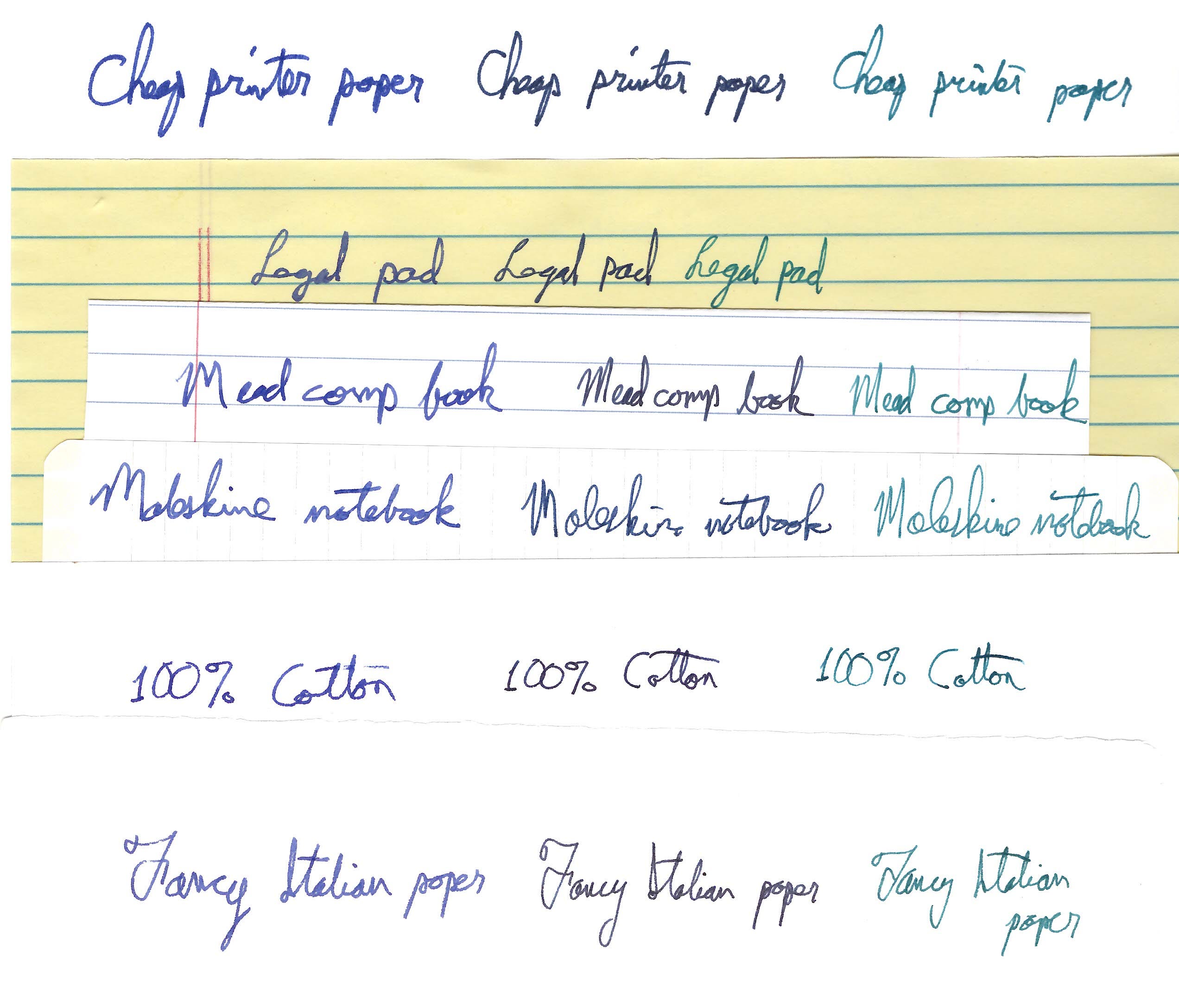
The pen on the left is a Jorg Hysek with a wide nib, and you can see that the cheap printer paper soaked up a lot of ink and left a thicker, fuzzier line. The legal pad wasn’t much better. Everything else basically worked. The 100% cotton paper is from a box I purchased a long time ago - it was marketed for printing resumes, back in the days when people printed resumes. It is the toothiest of all these papers and felt noticeably scratchier. I guess it goes without saying that fancy Italian paper is the best, but the comp book and moleskine work perfectly well with just about any pen.
(For those scoring at home, the middle pen is a Diplomat Aero and the one on the right is a Monteverde Invincia)
If the paper is thin, writing on one side can bleed through to the other, so the results can be slightly harder to read if you write on both sides. Which leads me to:
The ecosystem isn’t going to collapse if you use more paper. It’s cheap. Focus on what’s important here: your brain and your time. Write on one side. Trying to cram more words into a sheet will take you out of your natural and comfortable writing style and make you tired. Just buy a shitload of paper or notebooks or whatever it is you want to use, and use it.
There’s a reason cursive was invented. Don’t even think about not using it. It is far less tiring than printing one letter at a time. I learned cursive as a child. Then I went for many years without using it much, and forgot some of it. Later I re-learned it by sitting in my kid’s elementary school classroom during a parent-teacher conference and examining the forms printed on a long strip above the chalkboard (I still remembered how to do the lower-case letters, but I had forgotten some of the capitals).
Legibility was more important back in the day when written documents had to be read by other people. Hence the need for exacting penmanship, taught in schools to long-suffering children. This is probably the source of a lot of angst around writer’s cramp and ink disasters. Today, if you’re writing things down with ink on paper, you’re probably writing just for yourself, or perhaps for family members who can learn to recognize your handwriting.
To judge from the way people talk, a lot of them have memories of fountain pen disasters where ink got all over the place for some reason. Or perhaps it’s just generational trauma, handed down in an oral tradition. If the pen is working correctly, ink can only come out of it so fast. A couple of rare exceptions:
If the pen’s ink reservoir is partly empty, so that it contains an air bubble, and if it’s positioned nib down, then, when you go up in an airplane, the bubble will expand as the ambient pressure drops, forcing ink out the nib. Once I figured that out, I got in the habit of making sure my pens were positioned nib up when taking off in an airplane. If I have time I’ll also refill the pen before departure, to minimize the size of the air bubble.
Sometimes if a pen gets dirty, or if the nib is somehow damaged, the ink will stop coming out and you can restart it by giving it a little shake. If you do it just right, the ink flow restarts without incident, but if you overdo it, a few drops of ink might shoot out onto the page and become blots. This scenario happens a few times of year for me, only with one pen that has this problem. I blot it with a piece of scrap paper and move on.
Just have notebooks lying around, or on your person. Write grocery lists, doodles, notes on meetings, to-do lists, or stray ideas. Journal. Copy out good lines from books. Anything that has your mental focus will have a more enduring presence in your brain if you write it down.
I am left handed. I have never had any trouble with my hand smearing the ink. Yet every conversation I have about fountain pens leads to someone claiming that it can never work for them because they are left handed. I have no idea what they’re talking about. When I was a child, writing at length with pencil, the side of my hand sometimes became gray from graphite picked up as my hand rubbed across the page. And sometimes I have got ink on my hand when using a ballpoint pen that left an ink glob on the paper. But with fountain pens it’s easy to find a pen/paper combination such that the ink soaks into the paper and dries quickly enough that it doesn’t smudge when you’re writing the next line. Here’s a simple demonstration of drying time and how it works with two pens: first a fountain pen and then a Pilot G-2 gel pen.
Obviously the Pilot gel pen ink dries faster, and so that might be a better choice for people who are really worried about smudging.
Most modern pens allow you to choose between using preloaded plastic ink cartridges and a plunger that enables you to draw ink up out of a bottle by hand. I use both. Start with the ink cartridges, especially if you travel. There’s no need to complicate matters by messing around with bottles. Since I do a lot of work from one location, I have a corner of a tabletop set up there with ink bottles and a folded-up paper towel for wiping off the nib after it’s filled (I have been using the same paper towel for about twenty years). In theory this works better in the long term because it allows you to flush the nib by forcing ink in and out of it a couple of times whenever you refill. In practice I see no difference at all - pens that I refill with cartridges don’t get clogged.
Even if everything works perfectly you’ll end up with the occasional ink-smudged finger. It will wash off quickly - the ink is water-soluble. Until then, consider it a mark of distinction.
If you’re new to this I think it makes most sense to start by considering what kind of paper is going to work best in your life. Are you writing looseleaf, or in notebooks? Legal pads? Blue books? Remember, it’s okay to use lots of paper, so pick something that isn’t too precious and that is easy to replenish. I use a lot of moleskine notebooks and Mead comp books, which I can buy in bulk online. For composing fiction I use fancy looseleaf paper.
If you have access to a store where they sell fountain pens, take some of that paper there and see what works best. If you’re working with cheaper, thinner paper, start with finer nibs and work up to fatter ones until you start to see bleed-through.
Buy cheaper pens until you know what you like. I doubt there’s much of a difference between cheaper and more expensive fountain pens in terms of their actual performance. What you’re paying for, in an expensive pen, is fancy materials and styling. For example, if you look at the Pilot Vanishing Point line of pens - an ingenious fountain pen that you can click, like an old-fashioned ballpoint, to retract the nib inside the barrel - fancier versions cost five times as much as the base model.
In all honesty, the Pilot G-2 gel pens are going to give you 80% of what you could expect from a fountain pen for minimal cost.
On the other hand, a ten-pack of Pilot G-2 gel pens goes for about twenty bucks. For the same amount you can buy a simple but completely serviceable fountain pen that will last longer than you will.
No posts